

Building Tilt Monitoring: Wired or Wireless Inclinometers?
Nov 03, 2026
Building tilt monitoring measures changes in the angle of a structural element over time. For engineers planning a system on an existing building, the first question is not simply whether to buy a wireless inclinometer. It is how to obtain useful angle measurements, maintain reliable data collection and interpret changes in the correct structural context.
This guide compares wired and wireless arrangements for slow, long-term tilt monitoring. It does not define structural safety limits or replace an engineer-designed monitoring plan.
What can a building tilt sensor actually measure?
An inclinometer measures its own orientation relative to gravity. When securely coupled to a suitable structural element, it can track local rotation. It does not directly measure foundation settlement, crack width or the displacement of the whole building.
A single sensor cannot describe every part of a structure. Monitoring locations, reference measurements and any complementary survey or displacement instruments should follow the project engineer’s assessment. A changing reading can reflect structural movement, temperature effects, mounting movement or a measurement fault; interpretation requires more than an alarm threshold.
Wired vs wireless building tilt monitoring
Measurement performance and communication performance are separate. Adding a radio link does not improve angular accuracy, and temperature compensation does not improve radio coverage through concrete.
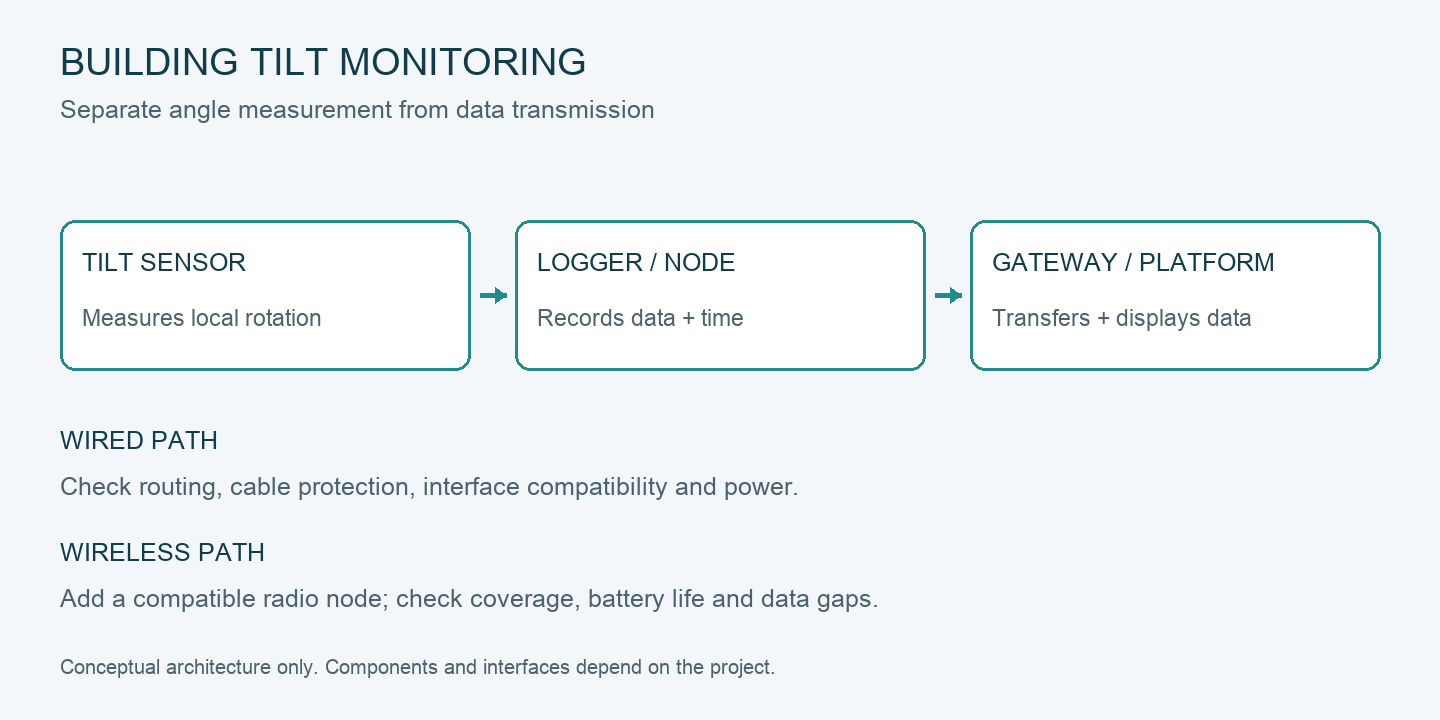
Conceptual monitoring chain: tilt sensor → logger or node → gateway and platform. A wired inclinometer can form part of a wireless system through compatible external equipment; wireless capability must not be assumed from the sensor model name.
Choose a wired arrangement when: protected cable routes and suitable power are available, and the project prioritises a maintainable physical connection. Check interface compatibility, cable length, shielding, grounding and surge protection against the equipment documentation.
Consider wireless transmission when: cable routing is difficult or monitoring points are dispersed. Validate coverage at the actual locations, including closed doors, reinforced concrete and gateway placement. Include radio nodes, power supplies and maintenance access in the design.
For either arrangement: specify time stamps, local data storage, missing-data detection and recovery after a power or communication interruption. “Wireless” does not automatically mean battery-powered or free of local wiring.
Building inclinometer selection checklist
Measurement objective: define the expected rotation, axes and smallest meaningful change. Do not select on resolution alone; review accuracy, repeatability, temperature behaviour and long-term stability separately.
Motion conditions: slow structural rotation differs from vibration or rapid motion. Do not assume a static accuracy specification applies while the structure is accelerating.
Mounting and exposure: agree locations with the structural engineer. Check bracket stiffness, fixing stability, environmental protection and connector exposure. An accessible façade detail is not automatically a suitable structural reference.
Power and communication: confirm the complete sensor–logger–gateway interface. For battery systems, request a power budget based on the intended measurement and transmission schedule rather than a generic battery-life claim.
Commissioning evidence: document orientation, initial readings, temperature, time settings and communication checks. Agree acceptance criteria and a maintenance plan before installation.
Which Vigor inclinometer series should you evaluate?
For slow or quasi-static building tilt measurements, start by reviewing the SST100, SST300 and SST400 static inclinometer options against the project’s measurement requirements. Confirm the exact range, accuracy conditions, output and environmental rating for the configuration being quoted.
If motion-related acceleration affects the measurement objective, discuss the SST810 dynamic inclinometer and the required test conditions with Vigor. It is not an automatic replacement for a static sensor in long-term monitoring. None of these recommendations implies an integrated wireless radio, battery, gateway or cloud service.
Frequently asked questions
Is a wireless inclinometer more accurate than a wired one?
Not inherently. Compare the sensor’s measurement specifications separately from delivery delays, missing readings and communication reliability.
Can tilt monitoring prove that a building is safe?
No. Tilt data is one input to a structural assessment. The responsible engineer must determine monitoring coverage, interpretation and the response to abnormal readings.
How often should readings be collected?
The interval depends on the movement being investigated and the required response time. Measurement, storage and transmission intervals may differ and should be specified separately.
Should temperature-related changes be filtered out?
Not automatically. Temperature can affect both the instrument and the structure. Record relevant temperature information and investigate correlations before changing filters or baselines.
Discuss your building tilt monitoring requirements
Send Vigor the intended measurement locations, expected angle range, required measurement performance, temperature range, motion conditions and preferred logger interface. Include any wireless transmission requirement so that sensor selection and system integration can be assessed separately.
Request an inclinometer configuration review or browse our inclinometer product range.
Further reading: Campbell Scientific: Building Structures, an overview of building data-acquisition systems and wired or wireless communication. It is not a specification for Vigor products.