

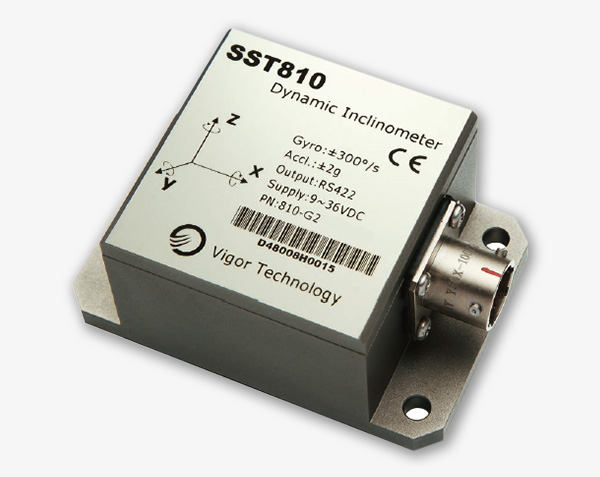
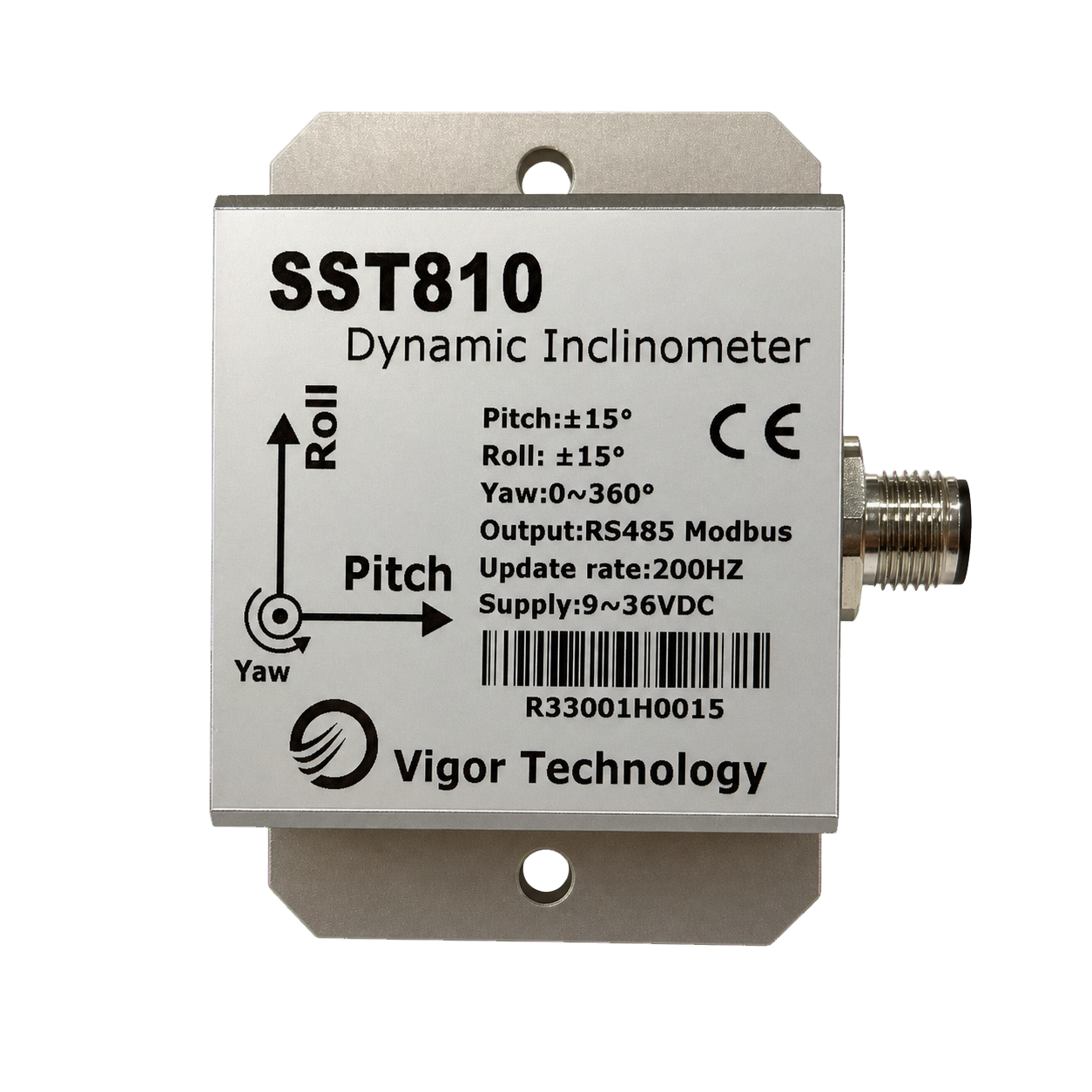
SST810 Dynamic Inclinometer Sensor
The Vigor SST810 is a MEMS-based dynamic inclinometer sensor for real-time roll and pitch measurement on moving, vibrating and oscillating equipment. Combining a triaxial accelerometer, triaxial gyroscope and Kalman filtering, it compensates for motion-related acceleration and operates independently without GPS or an odometer. The SST810 offers selectable dynamic accuracy down to ±0.02°, update rates up to 200 Hz, multiple measurement ranges and RS485 Modbus, CAN 2.0, CANopen or optional 4-20 mA output. Its IP67 housing, -40°C to +85°C operating range and flexible installation make it suitable for vehicles, ships, construction machinery, rail transit, robots, motion platforms and swing monitoring.
SST810 DYNAMIC INCLINOMETER SENSOR
OVERVIEW
The Vigor SST810 is designed for reliable roll and pitch measurement in dynamic environments. Conventional static inclinometers can be affected by linear acceleration, centripetal acceleration, vibration and wave motion. The SST810 combines a MEMS triaxial accelerometer, a triaxial gyroscope and a Kalman filter to calculate dynamic tilt while the carrier is moving. It works as a stand-alone sensor without GPS, an odometer or other external aiding equipment.
KEY ADVANTAGES
- Dynamic roll and pitch measurement for moving, vibrating and oscillating equipment
- Integrated triaxial accelerometer and triaxial gyroscope
- Kalman filtering for multi-sensor data fusion
- Selectable dynamic accuracy: ±1°, ±0.5°, ±0.3°, ±0.1°, ±0.05° or ±0.02°
- Dynamic angle resolution: 0.01°
- Digital update rate configurable from 0.5 to 200 Hz; analog output up to 200 Hz
- Full temperature compensation, orthogonal compensation and linear correction of the accelerometer and gyroscope
- Flexible mounting position; installation at the carrier's center of mass is not required
- Multiple industrial outputs: RS485 Modbus, CAN 2.0, CANopen and optional RS485 Modbus with 4-20 mA
- IP67 protection and operation from -40°C to +85°C
- Optional relative heading or magnetic heading output
- Customized, localized and redundant versions available
MEASUREMENT PERFORMANCE
Measurement ranges include ±5°, ±15°, ±30°, ±45°, ±60°, ±80°, ±90°, ±180° and 0-360°, with dual-axis or triaxial configurations available. Dynamic roll and pitch accuracy can be selected from ±1° to ±0.02°, depending on the application configuration. Static measurement options are also available, including accuracy down to ±5 arcseconds for selected ranges within ±30°, with resolution down to 0.0005°.
APPLICATION-SPECIFIC MOTION OPTIONS
The SST810 can be configured for different motion environments. General-motion and vehicle versions support gyroscope ranges up to ±300°/s and accelerometer ranges up to ±5 g. Ship-motion versions are designed for wave periods from 5 to 20 seconds and can optionally output heave data. Oscillating-swing versions support swing frequencies from 0.01 to 3 Hz. Anti-strong-vibration versions support gyroscope ranges up to ±2000°/s, accelerometer ranges up to ±16 g and vibration frequencies from 5 to 2000 Hz.
INDUSTRIAL INTEGRATION
The sensor operates from a 9-36 VDC supply and consumes less than 1 W. Available interfaces include RS485 Modbus, CAN 2.0, CANopen and combined 4-20 mA plus RS485 output. Output data can include roll and pitch angles, optional relative heading, triaxial acceleration and triaxial angular velocity. An M12 connector supports robust industrial installation.
ENVIRONMENTAL AND MECHANICAL DATA
- Operating temperature: -40°C to +85°C
- Storage temperature: -40°C to +85°C
- Protection rating: IP67
- Shock resistance: 1000 g at 1 ms, three-axis half-sine
- MTBF: at least 100,000 hours
- Dimensions: 81 x 54 x 28.5 mm
- Weight: approximately 240 g, excluding connector and cable
TYPICAL APPLICATIONS
The SST810 is suitable for vehicle attitude measurement, construction machinery, ships and marine equipment, rail transit, robots, motion platforms, photoelectric platforms, liquid-level compensation, power-line monitoring, tower-top vibration monitoring, hook-swing monitoring and other industrial systems that require real-time dynamic inclination data.
For model selection, specify the required measurement range, dynamic accuracy, static accuracy, output interface, heading option and target motion environment.