

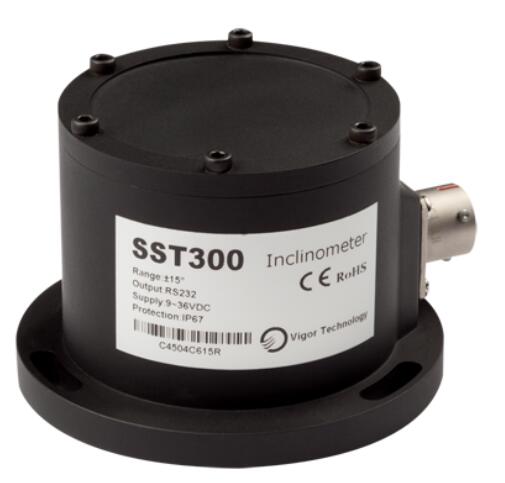
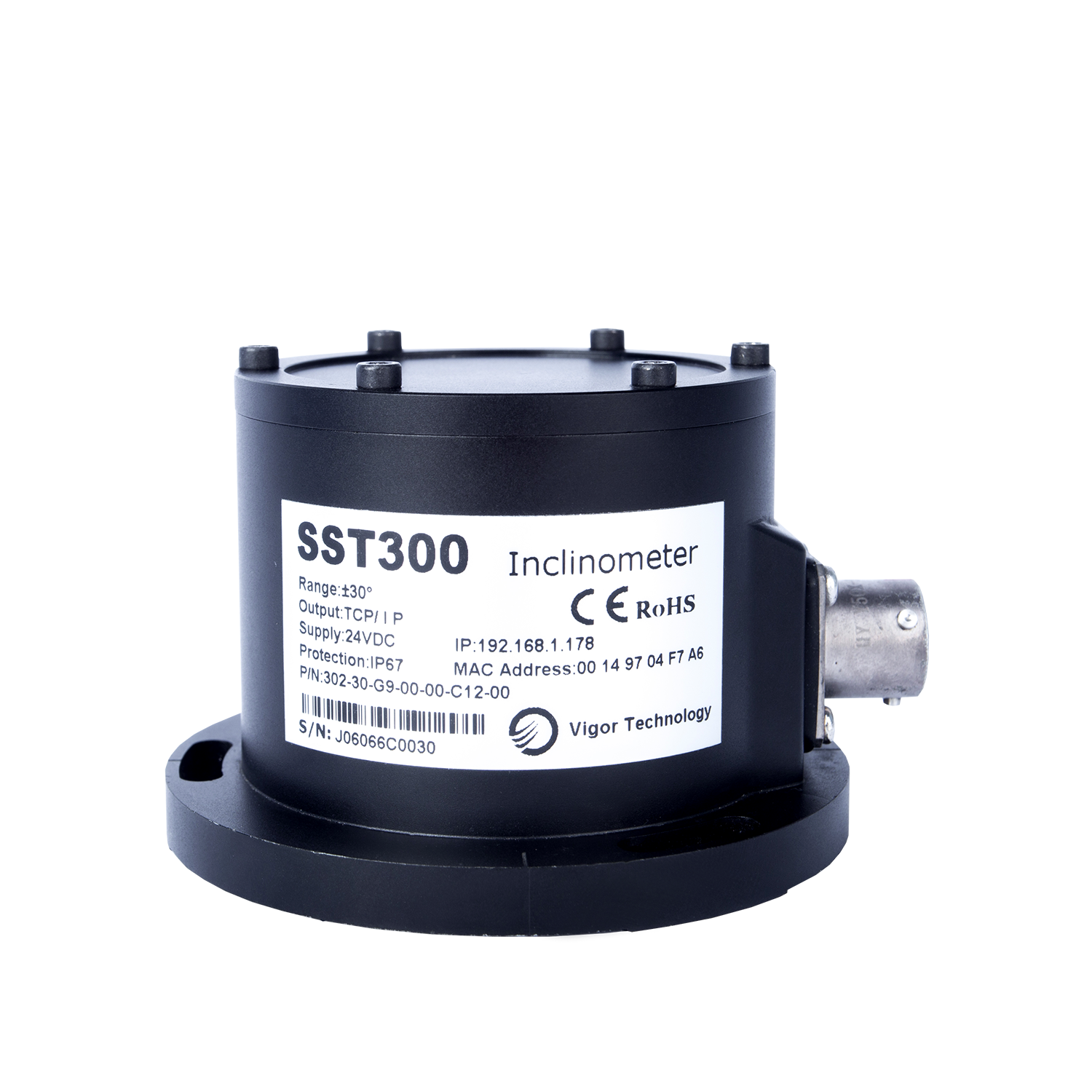
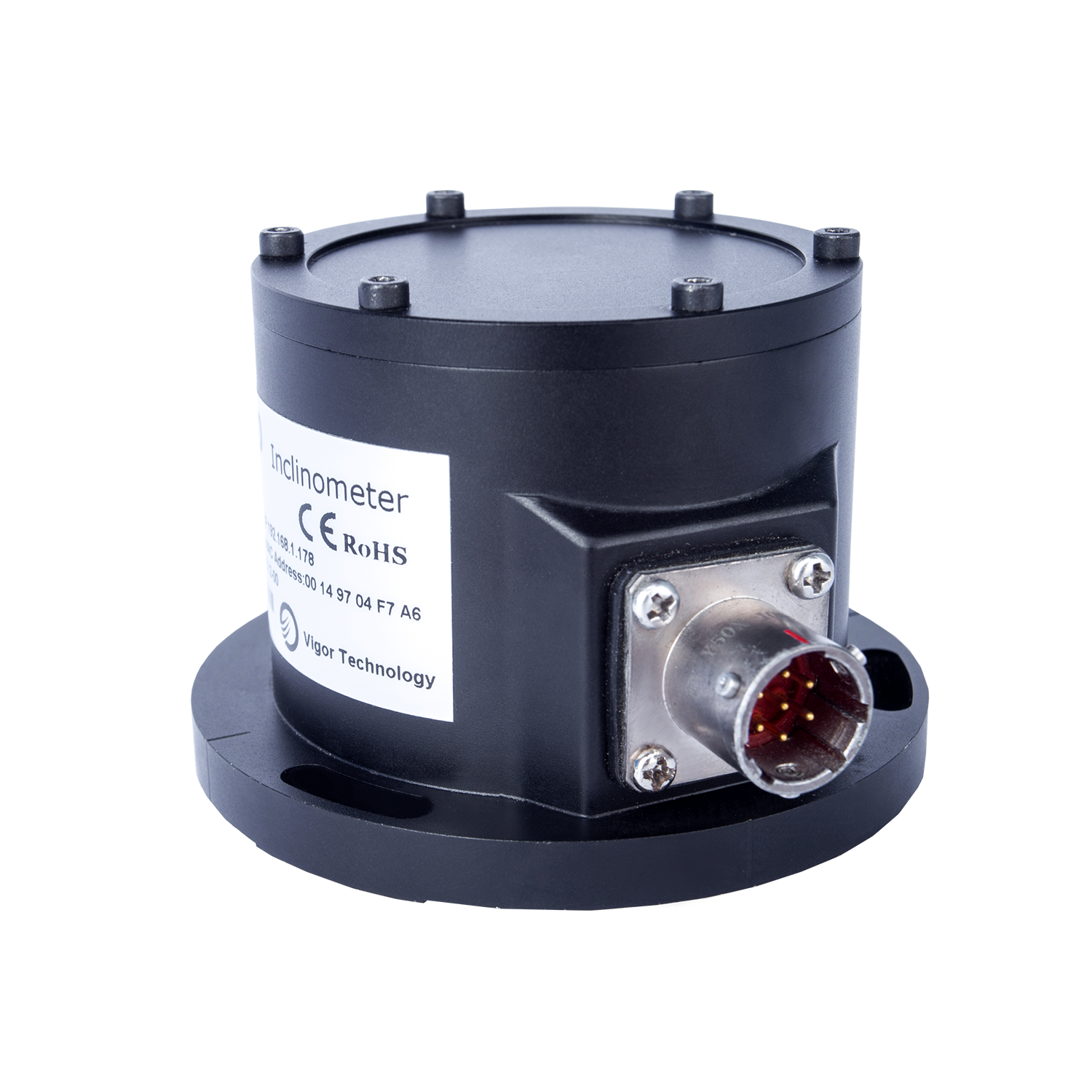
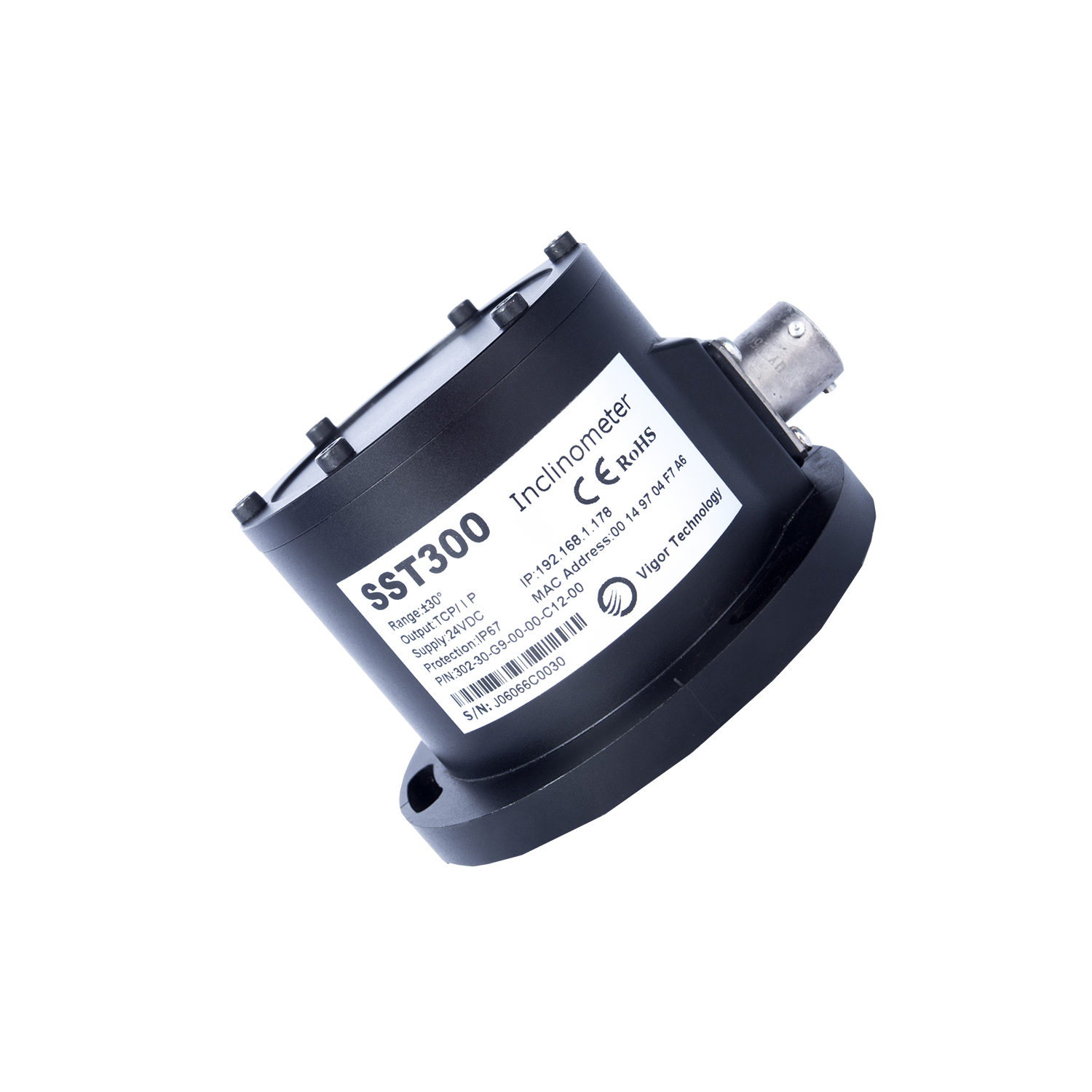
SST300 High-Performance Industrial Inclinometer
The Vigor SST300 is a high-performance industrial inclinometer for precision static tilt measurement in demanding environments. It offers single-axis or dual-axis measurement, ranges from ±5° to ±60°, and combined absolute accuracy up to ±0.01° at 25°C. Every sensor is individually calibrated for linearity, cross-axis error, repeatability, hysteresis, alignment and temperature drift. With vibration suppression, 9-36 VDC power, RS232 as standard and a broad selection of industrial interfaces and rugged enclosure options, the SST300 is suited to precision instruments, bridges, vessels, railways, construction, defense and factory automation.
SST300 HIGH-PERFORMANCE INDUSTRIAL INCLINOMETER
OVERVIEW
The Vigor SST300 is a high-performance inclinometer engineered for reliable static tilt measurement in precision industrial, infrastructure and defense applications. Based on MEMS accelerometer technology, it combines systematic reliability design, EDA/CAE simulation, controlled manufacturing and multidimensional calibration. Each unit is tested and compensated for temperature drift, nonlinearity, cross-axis error, zero offset, repeatability, hysteresis and installation alignment before shipment.
The result is a robust, application-ready sensor that maintains high accuracy after installation. Proprietary vibration-suppression technology can be adjusted on site to improve measurement stability in mechanically noisy environments, while a modular platform supports diverse communication interfaces, housings, cables and connectors.
KEY ADVANTAGES
- Combined absolute accuracy up to ±0.01° at 25°C
- Single-axis and dual-axis measurement options
- Measurement ranges of ±5°, ±10°, ±15°, ±30°, ±45° and ±60°
- Cross-axis error of ±0.1% FS
- Zero offset as low as ±0.005°
- Repeatability and hysteresis of ±0.0025°
- 0.0025° resolution and long-term stability of ≤0.02°
- Input-axis misalignment compensation for accurate field installation
- Proprietary, field-adjustable vibration suppression
- RS232 output as standard, with numerous optional industrial interfaces
- 9-36 VDC wide-range power input
- IP65 protection as standard, with optional IP67 configuration
- Military aviation connector and multiple rugged cable options
- Custom temperature compensation and special-purpose housings available
MEASUREMENT PERFORMANCE
SST300 performance is specified by measurement range. At 25°C, combined absolute accuracy is:
- ±5° range: ±0.01°
- ±10° range: ±0.015°
- ±15° range: ±0.02°
- ±30° range: ±0.04°
- ±45° range: ±0.06°
- ±60° range: ±0.08°
Comprehensive accuracy accounts for absolute linearity, cross-axis error, zero offset, repeatability and hysteresis. Cross-axis error is ±0.1% FS. Repeatability and hysteresis are both ±0.0025°. Zero offset is ±0.005° for ranges up to ±30° and ±0.008° for wider ranges. Resolution is 0.0025°, zero power-on repeatability is ±0.008°, and long-term stability is ≤0.02°.
INSTALLATION AND TEMPERATURE COMPENSATION
The SST300 accepts input-axis misalignment of up to ±4.0° on the ±5° model, with compensated limits matched to each wider range. This feature helps correct mounting deviation and improves effective measurement accuracy after installation.
An integrated temperature sensor covers -50 to +125°C with ±1°C accuracy. The inclinometer operates from -40 to +85°C and may be supplied with application-specific temperature-drift compensation profiles for different ranges and operating windows.
RESPONSE AND DATA OUTPUT
- Standard output: RS232
- Standard serial format: 115200 bps, 8 data bits, 1 stop bit, no parity
- Response time: 0.3 s at t90
- Standard refresh rate: 5 Hz
- Optional refresh rates: 10 Hz or 20 Hz
- Response frequency: 3 Hz at -3 dB
- Cold-start warm-up time: 60 s
Optional interfaces include RS485 with Modbus, RS422, CAN, CANopen, TCP/IP, USB 2.0, Wi-Fi, GPRS, 4-20 mA, 0-5 VDC, -5 to +5 VDC, 0-10 VDC and -10 to +10 VDC. This broad interface selection makes the SST300 easy to connect to PLCs, data loggers, computers, industrial networks and remote monitoring systems.
ENVIRONMENTAL AND MECHANICAL PERFORMANCE
- Input voltage: 9-36 VDC
- Average operating current: ≤50 mA
- Average power: ≤1.5 W at 25°C and 24 VDC
- Operating temperature: -40 to +85°C
- Storage temperature: -60 to +100°C
- EMC: compliant with EN 61000 and GB/T 17626 requirements listed in the product specification
- Insulation resistance: 100 MΩ
- MTBF: ≥25,000 operating hours per event specification
- Shock resistance: 100 g at 11 ms, triaxial half-sine wave
- Vibration resistance: 8 grms from 20 to 2000 Hz
- Protection: IP65 standard, IP67 optional
- Standard connector: military aviation connector compliant with MIL-C-26482
- Weight: approximately 420 g, excluding connectors and cables
RUGGED CONFIGURATION OPTIONS
Special housing options support demanding installations, including high-temperature exposure, underwater use, nuclear-radiation environments, beam-mounted applications, hazardous areas and low-temperature startup. Available cable and connector choices include aviation connectors, reinforced shielded cables, high-temperature cables, armored cables, watertight assemblies, angled plugs, explosion-proof assemblies, pigtails, USB, Ethernet and CAN/CANopen cables.
APPLICATIONS
The SST300 is designed for precision instruments, vessels, military equipment, security systems, railways, civil engineering, construction machinery, bridges, factory automation, scientific research and teaching. Its combination of calibrated accuracy, installation compensation and configurable industrial connectivity makes it especially suitable for projects where dependable long-term angle data is more important than high-speed dynamic response.
MODEL SELECTION
Customers can specify single-axis or dual-axis measurement, range, output interface, housing, connector and temperature-drift compensation. Select the ±5° model when the highest 0.01° combined absolute accuracy is required. Wider ranges provide greater measurement coverage with accuracy values defined for each range in the performance specification.