

Bridge Tilt Monitoring System Upgrade Checklist
Oct 17, 2026
Publisher: Vigor Technology
Content updated: 18 October 2026
A bridge tilt monitoring system upgrade begins with the measurement objective and the reason existing data are unreliable. For structural health monitoring, separate real bridge movement from sensor drift, mounting changes, temperature effects and faults in the acquisition chain.
This bridge monitoring system upgrade checklist follows three stages: diagnose the existing installation, select suitable bridge inclinometers and verify the replacement system against agreed project requirements.
1. Bridge tilt sensor drift and fault diagnosis checklist
Record each symptom, its possible causes and the evidence used to investigate it:
Sudden angle step: possible mounting movement, reset, zero change or structural event. Inspect fixings and compare raw data, configuration history and independent observations.
Slow change over days or months: possible structural movement, thermal response, mounting creep or sensor drift. Compare survey references, temperature records and calibration history.
Missing or intermittent readings: possible power, cable, connector or network faults. Review supply voltage and link logs and check data recovery.
Dashboard disagrees with sensor output: possible scaling, units, axis, time or filter mismatch. Trace the same timestamped sample from raw output to display.
How to check mounting and reference changes in bridge tilt monitoring
Inspect brackets, fixings, corrosion and the structural surface against installation records. Plan any removal with the monitoring team and document the baseline before disturbing a sensor.
How to check power and communication faults in bridge tilt monitoring
Inspect connectors, cable damage, shielding and grounding according to the system documentation. Compare error logs with site events. Nearby electrical equipment is a possible source of interference, not proof of the cause.
How to investigate bridge tilt sensor drift
Use a suitable calibrated reference and stable, documented comparison conditions. A brief constant-temperature bench check may reveal short-term instability, but does not establish long-term drift or distinguish every field effect.
2. Select a bridge inclinometer for the monitoring task
Define whether the target is long-term static inclination, slow structural movement or dynamic response to traffic and wind. Use the following selection checklist:
Range and axes: cover expected angles and the defined measurement directions.
Accuracy and stability: assess temperature behaviour, repeatability and long-term stability against the uncertainty budget.
Dynamic response: specify bandwidth, sampling rate, timing and latency when movement is part of the measurement.
Site protection: assess moisture, condensation, salt exposure, connectors and mounting materials; IP protection alone does not establish corrosion resistance.
Integration: confirm power, protocol, data logging, recovery and maintenance access.
Compare candidate product roles before requesting configuration-specific parameters:
SST100 static inclinometer: general static measurement where its specified performance meets the project requirement.
SST300 industrial inclinometer: precision static inclination monitoring.
SST400 high-precision inclinometer: higher-precision static angle measurement.
SST810 dynamic inclinometer: assess for a defined dynamic attitude task, using the applicable dynamic specifications.
Confirm range, accuracy conditions, axes and interface for the supplied version. These product roles are not interchangeable specifications.
3. Check the bridge monitoring measurement chain
Trace angle data from sensor to data acquisition, communications and monitoring platform. Verify the field power supply separately. An external radio, gateway or solar supply is a system component, not automatically a built-in sensor feature.
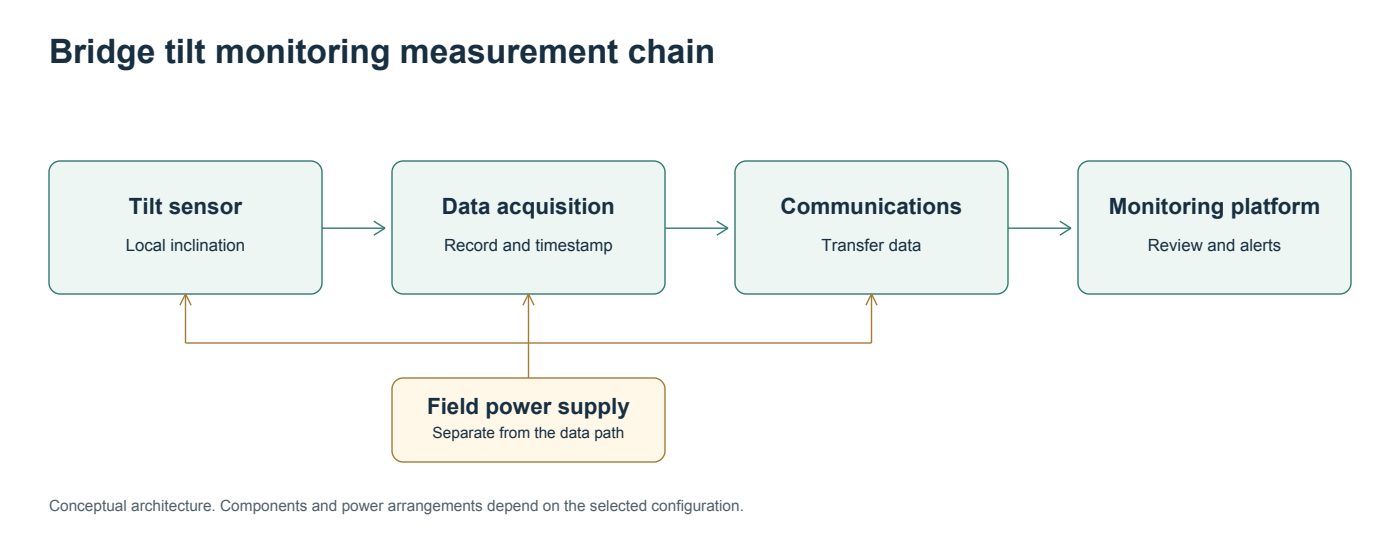
Conceptual measurement chain. Power is supplied separately to field devices; component choices depend on the installation.
4. Commission the upgraded bridge tilt monitoring system
Record sensor identifiers, mounting orientation, configuration and initial reference readings.
Compare readings with an appropriate calibrated reference, accounting for reference uncertainty and real structural motion.
Check units, timestamps, scaling, filters, data completeness and communication recovery.
Verify the approved alarm routing and handover responsibilities.
Choose a commissioning period covering representative conditions and retain deviations and acceptance records.
If load-response testing is required, its method, traffic arrangements and acceptance criteria must be designed and authorised by the responsible bridge engineering team.
Bridge inclinometer upgrade FAQs
How often should bridge inclinometers be calibrated?
Set the interval from the manufacturer’s guidance, measurement uncertainty requirements, calibration history and site exposure. Review it after damage, remounting or unexplained changes. Routine reference checks and formal recalibration are different activities.
What is the difference between static and dynamic inclinometers?
Static inclinometers measure gravity-referenced tilt under stationary or quasi-static conditions. Dynamic measurement must account for motion and non-gravitational acceleration. Specify the frequency range, dynamic accuracy and latency required by the monitoring objective.
How can temperature drift be distinguished from real bridge movement?
Compare synchronised angle and temperature records, a suitable reference and neighbouring instruments. Temperature can affect both the sensor and the bridge itself. Correlation alone does not prove sensor drift; assess mounting and structural thermal response before applying corrections.
Does inconsistent data mean a bridge tilt sensor must be replaced?
Check mounting, power, communications, timestamps and processing before replacement. Confirm whether an observed change is a sensor fault, a system error or real structural movement.
Can a bridge inclinometer measure displacement directly?
It measures local angle. Converting angle into displacement requires a justified geometry or structural model and uncertainty assessment; one local tilt reading does not determine overall bridge deformation or safety.
How should commissioning acceptance limits be defined?
The responsible engineer should define them before procurement using the monitoring objective, expected movement, reference uncertainty and applicable project requirements. A fixed logging duration alone cannot establish long-term performance.
Discuss your bridge monitoring upgrade
Send Vigor the monitoring objective, existing configuration, sample data, environment and required interface. Request model selection support.