

Dynamic Inclinometer Supplier Guide: SST810 Selection
Oct 17, 2026
Publisher: Vigor Technology
Content updated: 3 November 2026
When choosing a dynamic inclinometer supplier, compare performance under the motion your equipment will experience. A static accuracy figure alone cannot establish suitability for a moving vehicle, vessel or motion platform. This guide covers supplier checks, the SST810 specification options and sample evaluation before purchase.
Static vs dynamic inclinometers: which should you buy?
Static inclinometers suit stationary or quasi-static angle measurement; compare accuracy, temperature behaviour and stability.
Dynamic inclinometers address inclination during motion; compare error under defined acceleration, frequency and temperature conditions.
For parked platform levelling, assess a static sensor. For vessel roll or moving machinery, assess the relevant dynamic configuration.
Dynamic sensor fusion commonly combines accelerometer and gyroscope data. It does not eliminate every acceleration error, and a higher output rate does not by itself establish measurement bandwidth.
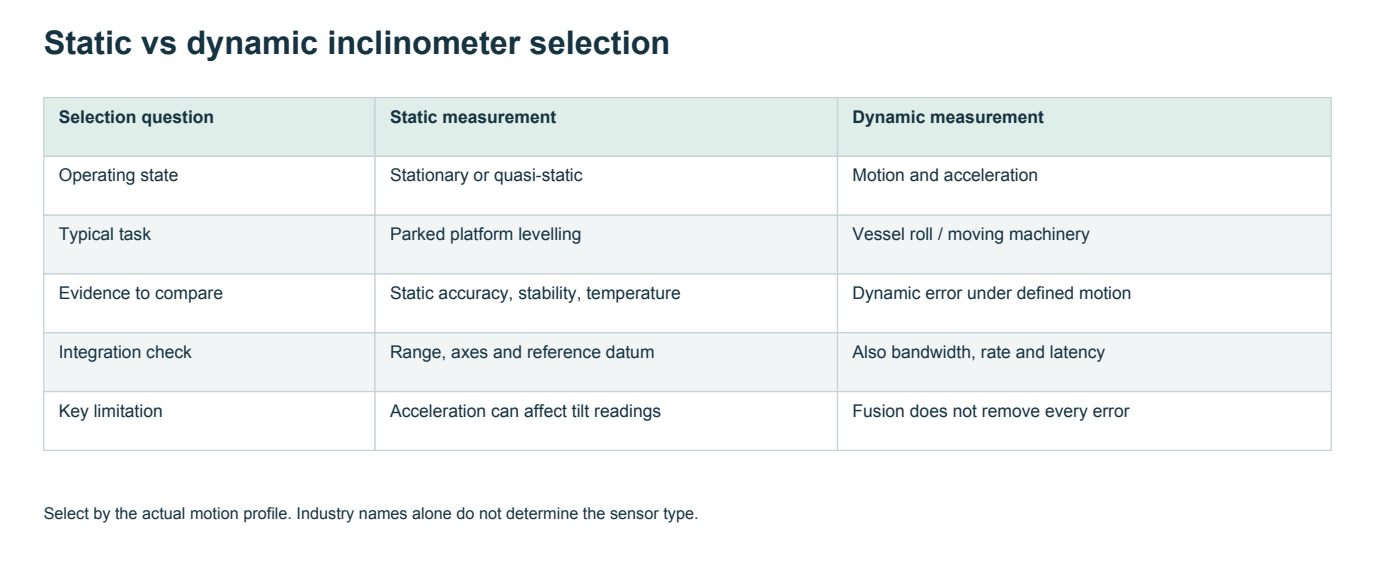
Static vs dynamic inclinometer comparison: match the operating state, measurement evidence and timing requirements.
SST810 dynamic inclinometer datasheet: specification summary
Vigor is an industrial inclinometer manufacturer. Its SST810 dynamic inclinometer combines a three-axis MEMS accelerometer, three-axis gyroscope and Kalman filtering for roll and pitch measurement. These features make it a candidate to evaluate where a gravity-only static measurement is affected by motion.
The supplied 2025 SST810 datasheet lists the following configuration options:
Dynamic roll/pitch accuracy grades: ±1°, ±0.5°, ±0.3°, ±0.1°, ±0.05° or ±0.02°.
Dynamic angle resolution: 0.01°.
Listed range options: ±5°, ±15°, ±30°, ±45°, ±60°, ±80°, ±90°, ±180° and 0–360°; confirm the required axes and range combination.
Digital output rate: selectable from 0.5 to 200 Hz. Analogue output is listed at 200 Hz.
Output options: RS485 Modbus, CAN 2.0, CANopen, or combined 4–20 mA and RS485 Modbus.
Supply: 9–36 VDC. Operating temperature: −40°C to +85°C. Enclosure protection: IP67.
These are family options, not one universal configuration. The datasheet does not define the complete motion test conditions for every accuracy grade. Confirm the offered version, achievable dynamic error, latency and interface settings with the supplier before ordering.
View the SST810 product specifications or request the current SST810 dynamic inclinometer datasheet and interface manual.
How to evaluate a dynamic inclinometer supplier
Request a configuration-specific quotation identifying range, axes, accuracy grade, output, motion version and included cables.
Match reports to the tested model and conditions; check method, reference uncertainty, date and traceability where applicable.
Ask how the inclinometer manufacturer verifies dynamic error and handles sustained acceleration, vibration, startup and recovery.
Compare suppliers against the same acceptance criteria, documentation, integration work and maintenance requirements.
Company age and general customer claims are background information. Base the purchase decision on evidence for the proposed sensor and application.
Before you buy a dynamic inclinometer: sample evaluation
Define the angle range, motion profile, environment and acceptance limits.
Verify the sample configuration, firmware, protocol and supplied documentation.
Record synchronised sensor and reference data under representative motion and temperature conditions.
Review angle error, latency, data completeness and recovery, and document any deviations.
Record mounting alignment and reference uncertainty. A sample result applies to the tested conditions; it does not certify performance in every environment. For stationary measurement, compare the SST300 and SST400 static inclinometer families separately.
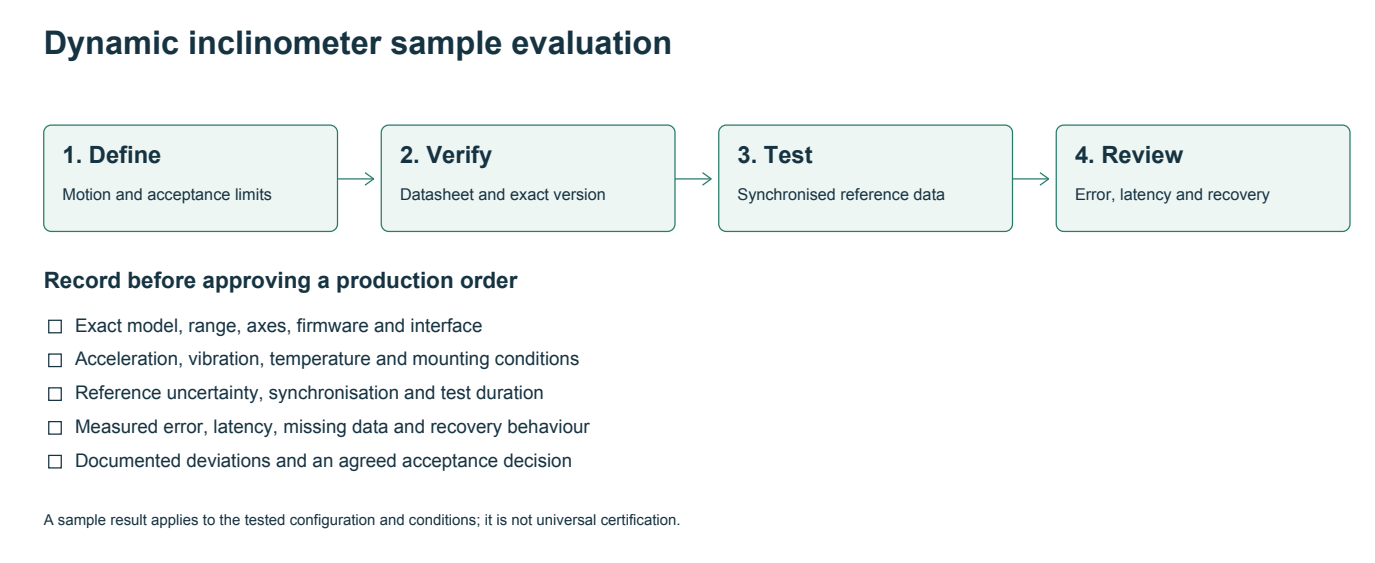
Sample evaluation workflow: define requirements, verify the configuration, test with a reference and review the evidence.
Dynamic inclinometer purchasing FAQs
Why is static accuracy insufficient for dynamic selection?
It does not describe errors during motion. Request dynamic results for the acceleration and frequency range relevant to the equipment.
Does the 200 Hz output rate mean 200 Hz measurement bandwidth?
No. Output rate is the frequency at which data are reported. Bandwidth and latency also depend on sensing and filtering; confirm them separately.
What should I include in a datasheet or quotation request?
Specify equipment type, axes, range, motion, target error, output rate, interface, power and environment. Ask for the exact ordering configuration and applicable test evidence.
Can I select ±0.02° accuracy for any operating condition?
No. It is a listed optional grade, not an unconditional field guarantee. Confirm its applicable motion conditions and configuration.
Where can I get the SST810 datasheet?
Use the datasheet request link above or email sales@vigordigital.com. Confirm the current revision and protocol for the offered version.
Request an SST810 quotation or evaluation sample
Contact Vigor about SST810 pricing, configuration and sample evaluation. Include your motion profile and acceptance criteria so the technical discussion can address the actual procurement requirement.