

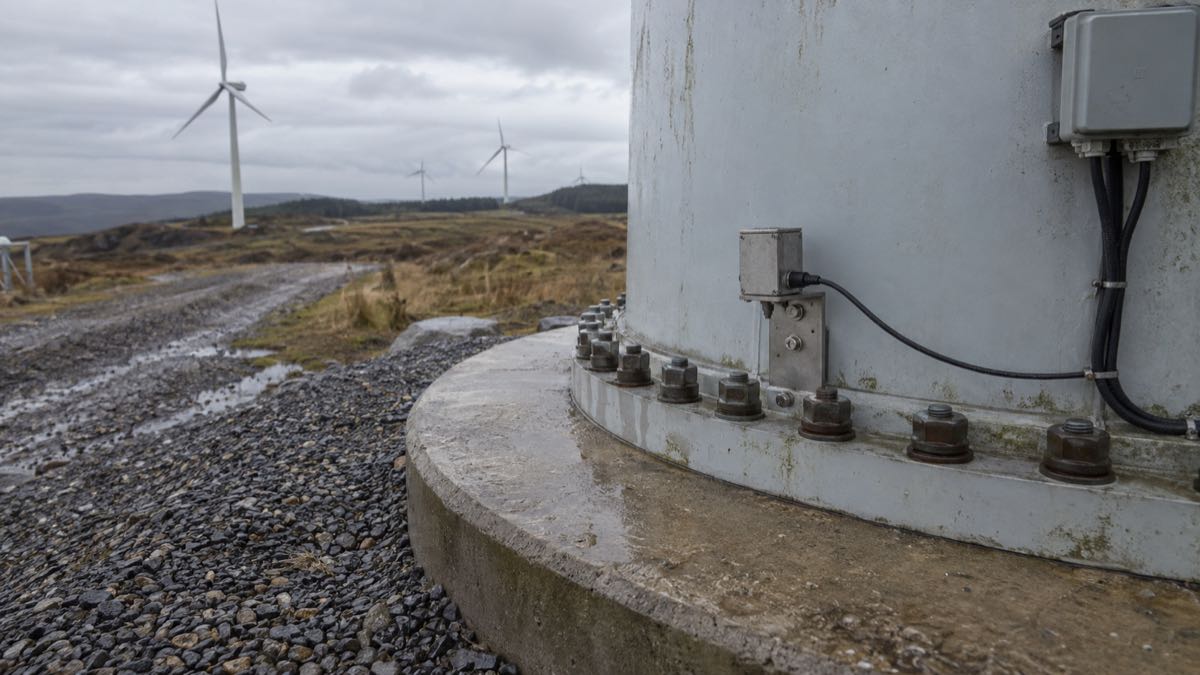
Wind Turbine Foundation Tilt and Settlement Monitoring
Vigor provided a long-term inclination and settlement monitoring architecture for wind turbine foundations operating in remote and environmentally demanding wind farms.
WIND TURBINE FOUNDATION TILT AND SETTLEMENT MONITORING
PROJECT BACKGROUND
Wind turbines are commonly installed in exposed or remote locations where foundations experience long-term environmental and operational loading. Changes in soil conditions, uneven settlement and repeated turbine loads can gradually alter the position of the concrete foundation. Because even small foundation movements affect the alignment of the entire tower, inclination and settlement must be monitored during maintenance and long-term operation.
THE MONITORING REQUIREMENT
The monitoring system needed to identify both absolute foundation tilt and changes in relative position over time. It also had to operate reliably for extended periods in an outdoor environment and transmit measurements from multiple turbines or monitoring points to a central platform.
VIGOR SOLUTION
Vigor configured a combined monitoring architecture using stable static inclinometers for concrete-foundation inclination and settlement sensors, including tilt-beam or hydrostatic-level configurations, for relative settlement measurement.
The inclinometer established the angular condition of the tower foundation. The settlement system measured relative vertical displacement between selected points. Together, these measurements allowed maintenance teams to distinguish an overall change in foundation attitude from localized differential settlement.
SYSTEM CONFIGURATION
- Static inclinometers for absolute foundation inclination
- Settlement sensors for relative vertical displacement
- Multiple monitoring points around the tower base or between foundations
- Wired options including RS485, Ethernet and CAN
- Wireless options including Wi-Fi and cellular transmission
- Central data acquisition for trend analysis and remote review
- Outdoor installation selected according to site protection requirements
HOW THE SYSTEM WORKED
Reference values were recorded after installation or during a confirmed stable condition. Subsequent measurements were compared with the baseline to identify gradual tilt, local settlement or changes between monitoring points.
Rather than relying on a single inspection, the system produced a time history of foundation behavior. This made it possible to evaluate whether movement was stable, seasonal or continuing, and to schedule a closer engineering inspection when a project-defined threshold was reached.
MONITORED CONDITIONS
The system was designed to support monitoring of:
- Tower-base absolute inclination
- Relative tilt change over time
- Differential foundation settlement
- Relative displacement between selected points
- Long-term movement trends across multiple turbines
PROJECT VALUE
Combining tilt and settlement measurements provided a more complete view of foundation condition than either measurement alone. Remote transmission reduced the need for frequent manual readings at distant wind-farm locations. Trend data supported maintenance planning and helped engineers focus field inspections on turbines showing measurable change.
APPLICATION RELEVANCE
This approach is applicable to onshore wind turbine foundations, wind farm civil structures and other tall infrastructure supported by large concrete foundations. Sensor range, accuracy, installation geometry, sampling interval and alert thresholds must be defined by the project's structural engineer and site conditions.