

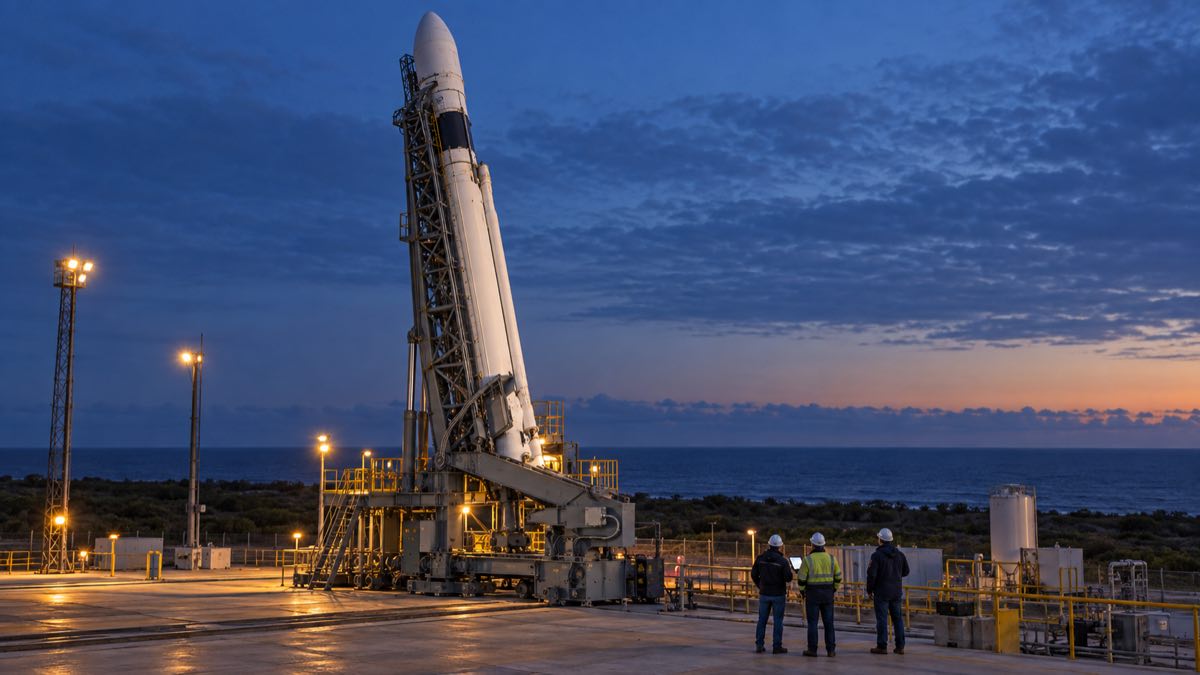
Rocket Launch Erector Leveling and Attitude Monitoring with SST3836
The SST3836 rugged inclinometer provides pitch and roll feedback for rocket launch erector leveling, erection control and pre-launch attitude verification.
ROCKET LAUNCH ERECTOR LEVELING AND ATTITUDE MONITORING WITH SST3836
PROJECT BACKGROUND
A rocket launch erector must move a launch vehicle from its transport or assembly position to a precisely controlled launch attitude. During positioning, erection and pre-launch preparation, the support structure must remain within project-defined pitch and roll limits. Small angular errors can affect mechanical alignment, interface loads and the repeatability of subsequent operations.
THE MONITORING REQUIREMENT
The launch-support system required continuous two-axis inclination feedback from a sensor mounted directly on the erector structure. The device needed to withstand outdoor temperature variation, vibration and mechanical shock, operate from the vehicle or platform DC supply, and communicate reliably with the control system. Because the installation zone may be subject to site-specific hazardous-area requirements, the selected configuration also required a protected enclosure and armored cabling.
VIGOR SOLUTION
Vigor configured the SST3836 explosion-proof inclinometer as the attitude-feedback device for the launch erector. Mounted on a rigid, calibrated surface of the launcher frame, the sensor measures pitch and roll as the structure is leveled and raised. Its data is transmitted to the control unit through an industrial communication interface, allowing operators or the control logic to compare the measured attitude with the required position.
The SST3836 combines a corrosion-resistant aluminum enclosure, IP66 ingress protection, a flameproof connector and armored cable. The product supports dual-axis ranges from +/-5 degrees to +/-180 degrees and operates from 9-36 VDC. Output configurations include RS485/Modbus, CAN-family interfaces and optional 4-20 mA, enabling integration with different ground-support control architectures.
SYSTEM CONFIGURATION
- Monitoring target: rocket launch erector or launch-support frame
- Measurement: two-axis pitch and roll
- Sensor: SST3836 rugged explosion-proof inclinometer
- Installation: rigid mounting on a calibrated structural reference surface
- Communication: RS485/Modbus, CAN option or project-specified analog output
- Power supply: 9-36 VDC
- Environmental protection: IP66 enclosure with armored cable
- Alarm logic: project-defined angle limits handled by the control or monitoring system
HOW THE SYSTEM WORKS
After mechanical installation, the launch frame is placed at its reference position and the sensor zero is verified. During leveling, the inclination reading helps the ground crew confirm that the base and support structure are correctly aligned. As the erector raises the vehicle, continuous pitch and roll measurements provide independent attitude feedback throughout the controlled movement.
At the pre-launch position, the monitoring system compares the measured angles with engineering tolerances. If an abnormal change or excessive cross-axis tilt is detected, the control system can stop the operation or request inspection according to the project's safety logic. The inclinometer supplies measurement data; all interlocks and permissible limits remain the responsibility of the launch-system engineer.
PROJECT VALUE
Direct measurement on the launch structure provides objective angle data during setup and erection. The rugged sensor construction supports use in exposed ground-support environments, while industrial interfaces simplify connection to existing controllers and data-acquisition equipment. Continuous records also support commissioning, maintenance and repeatability checks between operating cycles.
APPLICATION RELEVANCE
This solution is suitable for launch erectors, aerospace ground-support platforms, antenna positioning structures and other large mechanisms that require controlled inclination feedback. The SST3836 nameplate, certification and selected measurement configuration must be verified against the installation environment and local safety requirements before use.